
Industry news
U.S. Toy Sales Up 20% in 2026: Squishies Hit $671 Million as Adults and Social Commerce Reshape Demand
Circana's November 12 data: U.S. toy sales up 20% in the first nine months of 2026, squishy toys at $671 million, and TikTok Shop now the fourth-largest toy retailer. What it means for wholesale buyers planning the 2027 spring range.
In brief
What you’ll learn
Circana reports U.S. toy sales up 20% in the first nine months of 2026, led by squishies at $671 million, adult collectors, and TikTok Shop.
Overview
Circana's latest U.S. toy market data, released November 12, puts a hard number on the year every wholesale buyer has felt: dollar sales rose 20% in the first nine months of 2026, with unit sales up 18% and average selling prices up just 2%. The growth is not coming from the children's aisle alone — adults, collectors, and social commerce are doing the heavy lifting. And the single most striking line in the data belongs to squishy toys, which generated $671 million in sales through September, six times more than a year ago.
What the numbers actually say
The breadth of the growth is what makes it credible. Ten of the 11 toy supercategories posted year-over-year dollar growth, and eight also grew in units. The fastest-growing categories were Explorative and Other Toys, up 75% on the strength of sports cards; Games & Puzzles, up 45%, driven by strategic trading cards; Arts & Crafts, up 23%, boosted by slime-making kits; and Building Sets, up 17%. The industry's largest declines, by contrast, were concentrated in outdoor, active, and seasonal play — the categories that depend most on weather and one-off occasions. That pattern matters for range planning. Growth in 2026 is coming from products people collect, build, make, and trade — activities that repeat all year — rather than from seasonal spikes.
The squishy story: from sensory toy to self-expression
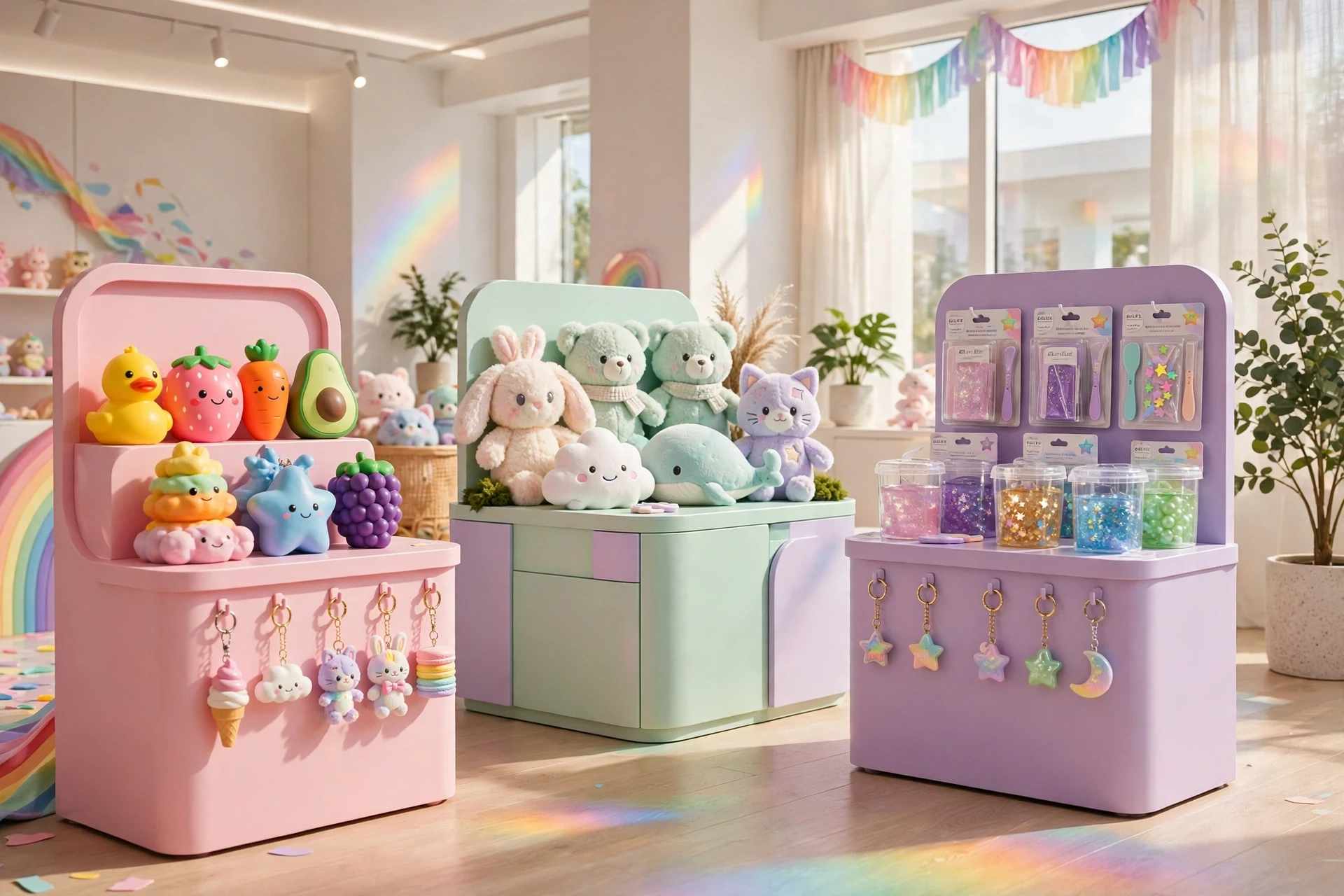
Squishies are the headline for a reason. At $671 million through September — six times the same period last year — the category has grown from a sensory niche into one of the year's defining toy stories. Circana's Kristen McLean puts the shift plainly: social platforms are turning squishies "from simple sensory toys into highly shareable forms of self-expression, fueled by surprise formats, character-driven designs, and impulse-friendly price points." The wave extends beyond the squishy itself. Keychains, bag charms, plush clips, and similar accessories have surged as shoppers use toy-inspired products to personalize backpacks, handbags, and everyday items — keychain sales are up more than 200% year to date. For buyers, that means the squishy opportunity is not a single product: it is a family of formats — figures, surprise and blind formats, and wearable accessories — that all ride the same demand.
Adults are now the growth engine
The second structural shift is who is buying. Consumers aged 12 and older accounted for the majority of toy industry growth through September. Collectible toy sales grew 56%, and licensed toy sales rose 27%, as shoppers buy toys to collect, display, and express personal interests — and to take part in communities built around sports, gaming, entertainment, and pop culture. Sports-themed properties were among the year's defining trends, and trading-card franchises remained the industry's top property group. This changes the buyer, not just the product. Packaging and display now need to speak to collectors and gift-givers as well as parents, and assortments built only around young children will miss where the money is moving.
Social commerce rewrites discovery
The path to purchase is changing as fast as the products. Toy sales through TikTok Shop nearly tripled this year to $1.6 billion, making the platform the fourth-largest toy retailer in the United States and nearly 5% of all toy sales. Nearly half of consumers report buying a product after seeing it on social media, and creators and online communities now play a central role in shaping what gets discovered. For wholesale buyers, the implication is practical: products that demonstrate well on camera — that can be squeezed, opened, built, or revealed in a few seconds — have a structural advantage in the channel where discovery now happens. A product that does not film well will struggle to move, however good its landed cost.
What it means for wholesale buyers
Four judgments follow from the data. First, treat squishies as a category, not a spike: $671 million and sixfold growth, plus the accessory crossover, argue for breadth across characters, formats, and surprise play rather than a bet on one design. Second, plan for the adult buyer — collector-friendly presentation and giftable formats belong in the spring range. Third, buy for the camera: social discovery rewards products with a visible, shareable moment. Fourth, keep safety in the selling story: a Toy Association survey this month found 87% of parents say a knockoff toy's lower price is not worth the safety risk, so factory-direct, properly tested product is itself a competitive edge. Circana expects the same drivers — collectibles, licensed merchandise, building sets, sports-related products, arts and crafts, and fandom-driven toys — to lead the holiday season, with promotions and value still important as household budgets stay tight. Christmas stock, however, is already in the country; this data is a map for the 2027 spring range, not a Christmas reorder list. The buyers who act on it now will be the ones whose shelves match what the market is actually buying. HundredPower, a Hong Kong-headquartered toy manufacturer with its own factory in Shenzhen and a catalogue spanning party supplies, novelty gifts, glow toys, and bubble toys, follows these shifts so its wholesale partners can stock what the market is actually buying.
Common buyer questions
Frequently asked questions
Does a 20% sales jump mean I should order more for the holidays?
Not for Christmas — most holiday stock has already landed in the U.S., and the selling season is underway. Use this data to shape the 2027 spring range: squishy and sensory formats, collectibles, arts and crafts, and accessory-style products such as keychains and bag charms.
Are squishies a fad or a real category?
The scale argues for a real category: $671 million through September, six times last year, with the same demand spilling into keychains and bag charms, up more than 200%. The risk is not the category but concentration — a single design can fade while the category keeps growing, so breadth across characters and formats matters more than chasing one hit.
How does TikTok Shop's rise change wholesale buying?
Discovery now happens on social platforms, and TikTok Shop alone is nearly 5% of U.S. toy sales. Products need a visible moment — a squeeze, an unboxing, a reveal — that works in a short video, and suppliers who can serve social sellers and collector-focused shops will see the demand first.
Put the guide to work
Send a clearer toy sourcing brief.
Share the product, expected quantity, target market, packaging, destination and open questions. The HundredPower sourcing team will review the project context before the next quotation step.