
Buying guide
Squishy Toys Wholesale: Materials, Buyer Checks and Custom Options
Sourcing squishy toys wholesale? A factory-side guide to the formats and materials that sell, the checks to run before you order in bulk, and how custom squishy toys are built with your own brand.
In brief
What you’ll learn
Squishy toys wholesale turns on four things: material choice, odour control, print durability and packaging. Before ordering in bulk, ask the factory for its material specification and test reports, judge the smell from a production-sealed unit, and run a repeated squeeze test on the sample — then customise shape, colours and packaging to make the product your own.
Overview
Squishy toys look simple — a soft shape a child squeezes, which then slowly rises back. For wholesale buyers the simplicity is deceptive: material choice, odour control, print durability and packaging decide whether a line sells through or comes back as complaints. This guide is written for importers, wholesalers and online sellers sourcing squishy toys wholesale: the formats worth stocking, the questions to put to a squishy toy manufacturer before you commit, and the customisation that turns a generic squeeze toy into your own product.
The formats and sizes that move
Almost everything in this category is built on one mechanic: slow rise. The buyer-relevant differences are shape, size and finish.
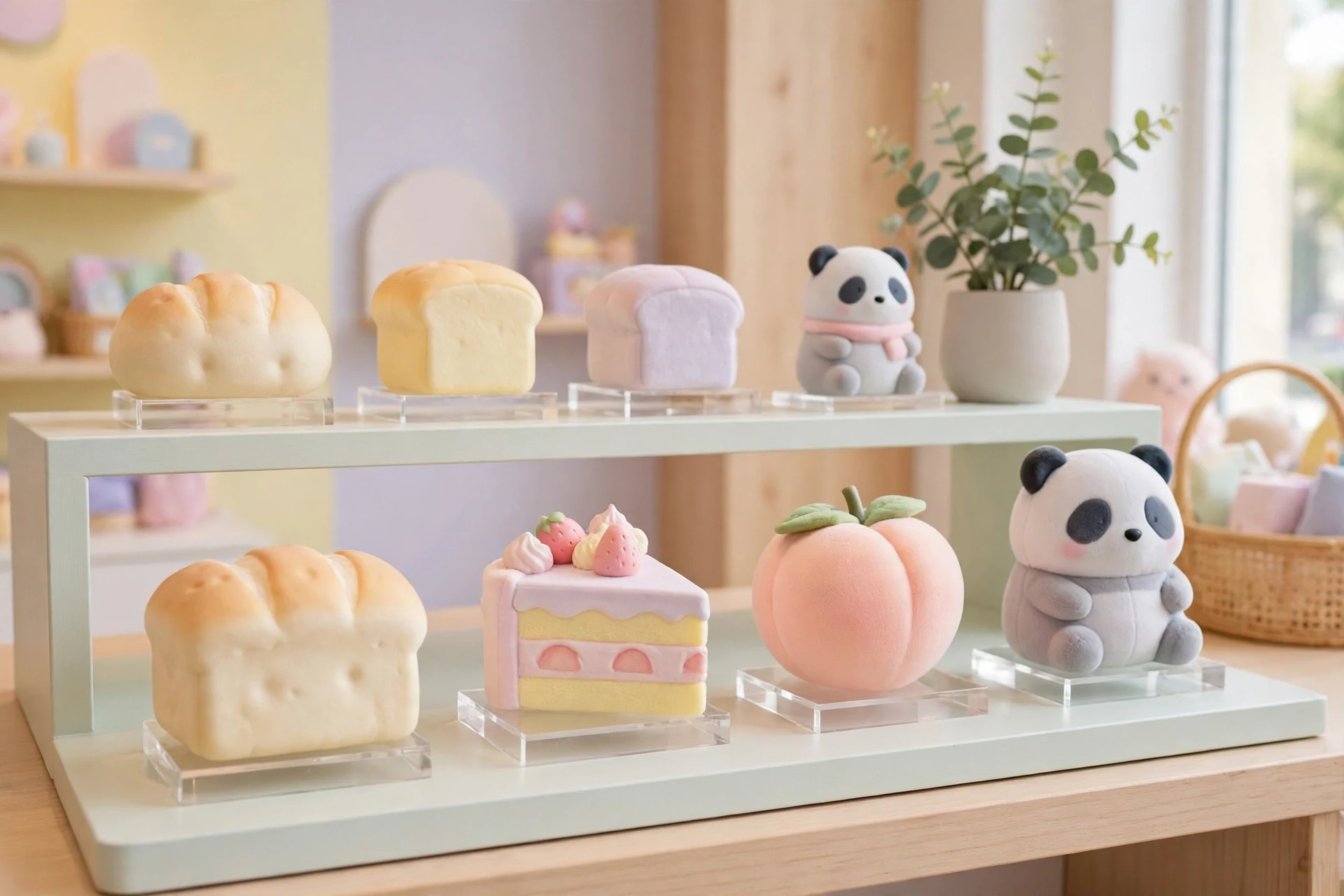
- **Food shapes are the evergreen line.** Bread, fruit, cakes and desserts read instantly on a shelf or in a photo, and carry no character-licence risk. Animals and cute everyday objects run a close second. - **Size tiers do different jobs.** Minis work as keychain and pocket-money items. Palm-size pieces are the volume standard — big enough to show print detail, small enough for impulse placement. Jumbos work as display pieces and gifts. Stock all three tiers as a ladder, not a flat list of shapes. - **Finish sells the squeeze.** A matte, skin-like surface with clean painted detail feels a grade above a glossy, roughly printed one — when two factories quote differently, the finish is usually where the difference hides.
Materials and safety: questions to put to the factory
Squishies are a hand-and-face product, so materials are the most important conversation you have with a squishy toy manufacturer — and every point below is something to request and confirm in writing, not assume.
- **Ask what the toy is made of.** Most slow-rise squishies are PU foam; other lines use different soft materials with a different feel and rise speed. Ask for the material specification in writing, including colouring and coating. - **Ask about odour control.** A sealed pack can trap a strong chemical smell — the category's most common complaint. Ask how long pieces rest and air before sealing, and judge smell from a production-sealed unit, never an open sample. - **Ask for test reports that match your market.** Request the factory's reports for the material and finished product, confirm they correspond to your market's toy requirements, and confirm the age grading and warning labels printed for your order. - **Ask how print durability is checked.** Printed faces get rubbed and stretched in use. Ask what adhesion and rub testing the factory does, then repeat a simple version on the sample.
Custom squishy toys: where your margin gets built
An unbranded squishy is a commodity; a custom one is your product. The standard options from a squishy toy manufacturer:
- **Your shape and print.** A new shape developed from your artwork or reference, or an existing shape in your colourways, with your logo or design printed on the piece. - **Your packaging.** Sealed bag with header card for peg displays, individual colour boxes for gifting, and counter display boxes for till-point placement. - **Display logic.** Squishies are an impulse category: they perform at checkouts, party-supply shelves and seasonal displays, where customers add one to a basket rather than planning the purchase. Packaging that shows the squeeze — a window or a "squeeze me" panel — converts better than a closed box.
Five checks before you order in bulk
- ☐ **Squeeze the sample properly.** Full compression, twenty times. Watch the rise time; inspect seams and thin points for splitting or tears. - ☐ **Smell a sealed unit.** Open a production-sealed pack, not the shelf sample. If it smells strong, the run will too. - ☐ **Get the paperwork.** Written material specification, the factory's test reports for your market, confirmed age grading and labelling. - ☐ **Rub the print.** Hard rub with a dry cloth, then a damp one. Flaking or colour transfer only gets worse in use. - ☐ **Check the pack.** Seal quality, barcode readability, warning text, and pieces sitting in the display box without crushing.
Where HundredPower fits
HundredPower designs and manufactures light-up toys, bubble toys and squishy toys in its own factory, with a Shenzhen office and production in Zhongshan, China. Buyers come to us for custom squishy toys built to their brief — their shape or ours, their colours and print, retail packaging under their own brand — starting from one case, so a listing or shelf can be tested before scaling to bulk squishy toys orders. Send a reference photo, your artwork, or just the shape category you are targeting, and our team will reply with options and prices.
Common buyer questions
Frequently asked questions
What are squishy toys made of?
Most slow-rise squishy toys are PU foam, which gives the soft feel and slow rebound the category is known for; other soft materials suit firmer or faster-rise lines. Ask the factory for the material specification in writing before you order.
Why do some squishy toys smell strong, and how do buyers manage it?
Fresh foam pieces can carry a chemical smell that a sealed pack traps in. Factories manage it by resting and airing pieces before packing. Judge the smell from a production-sealed unit, not an open sample.
Can I order custom squishy toys with my own shape and branding?
Yes — standard OEM and ODM work. A manufacturer can develop a shape from your artwork, apply your colours and print, and pack the pieces under your brand.
What is the difference between mini, standard and jumbo squishies for a buyer?
Role, mainly. Minis are pocket-money and keychain items, palm-size pieces carry the volume, and jumbos work as gifts and shelf display.
How do I get a quotation from HundredPower?
Send the shape or reference photo, your estimated quantity, target market, packaging requirements and destination through the inquiry form or WhatsApp/Messenger on hundredpower.com. The team replies with options and prices.
Put the guide to work
Send a clearer toy sourcing brief.
Share the product, expected quantity, target market, packaging, destination and open questions. The HundredPower sourcing team will review the project context before the next quotation step.